
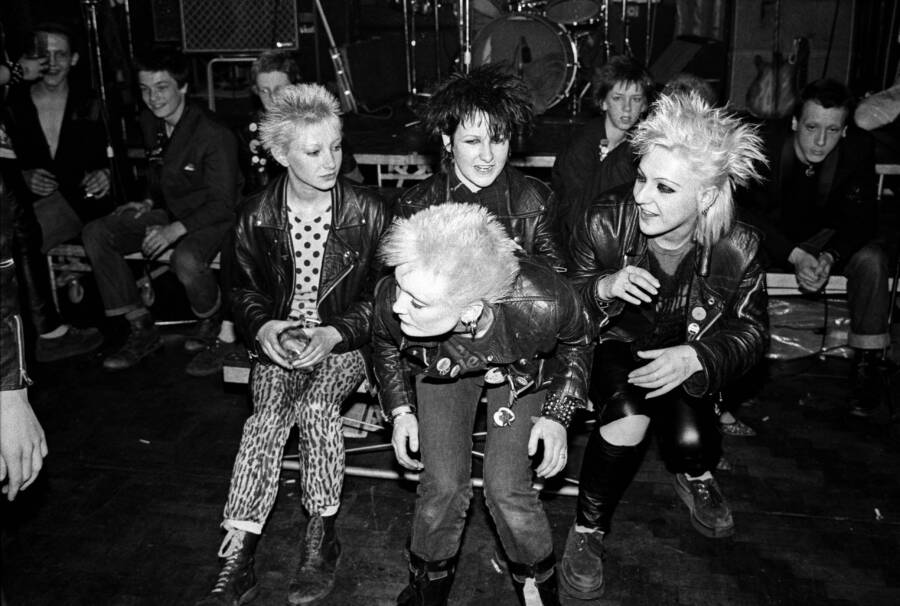
The 1970s was a decade of Troubles, early Thatcherism, blackouts, and nationwide strikes. This large-scale unrest of 70s Britain also prompted the arrival of punk; an alternative subculture first established by a minority of working-class youth in London. This unconventional community was united by its anarchic approach to social and political issues of the time, inspiring rebellious new styles in both fashion and music. The punk music scene was launched with now-iconic bands such as Joy Division, Rezillos, Wire, and The Clash. Arguably the most paradigmatic and influential band of this new punk movement was the Sex Pistols, fronted by Johnny Rotten; an outspoken critic of the British government, class structure, and Catholic Church, he became the epitome of punk. The band played their first gig at Saint Martin’s School of Art and took their name from the anti-fashion boutique “SEX”, run by Malcolm McLaren and Vivienne Westwood, highlighting the firm and long-lasting relationship between music and fashion in punk culture.
As a subculture primarily comprised of young people from poor socioeconomic backgrounds, affordability played a key role in the early stages of punk fashion; the style was rooted in Marxism and the needs of the working class. The punk generation sought to express themselves, and their opinions, through their clothes without contributing to the capitalist consumption for which they held such disdain. This led to the punks opting for DIY alternatives; stitching logos onto hand-me-down items to represent their socio-political stances, embellishing shirts with cheap accessories such as safety pins, and scrawling contentious graphics onto old t-shirts and jackets. Anti-capitalist, anti-materialist, anti-conventionalist. Punk fashion was a defiant force of rebellion which refused to obey the norms of 1970s British society.
Crowned by Vogue as “the queen of punk”, Vivienne Westwood’s esoteric style is the archetype of punk and alternative fashion. Tartan, leather, studs, slogans; her creations are a visionary melange of punk, new romanticism, and activism. Other non-conformist designers – Jean Paul Gaultier and Zandra Rhodes – incorporated elements of punk style into their garments and elevated it to high fashion circles, propelling punk into the mainstream fashion world. With this unfamiliar look becoming hugely popular at seasonal fashion shows in London, Paris, Milan, New York, the demand for punk style clothing grew. As is often the case, this has led to a trickle down of designs from high fashion to fast fashion.
#grwm #alt #punkaesthetic: Punk style has had a recent resurgence in popularity thanks to TikTok, a concerningly influential platform. Users show off their “punk style” outfits, talking through where items were purchased. In videos garnering thousands of views, fast fashion labels Nasty Gal, Urban Outfitters, and SHEIN are mentioned time and again. These unethical, hyper-capitalist companies leech off subcultures, produce poorly made gimmicks of authentic styles, and strip them of their legitimacy. Punk is not solely about aesthetics, but its socio-political ideology. Punk has been snatched up by the greedy hands of fast fashion companies and rejigged into nothing but a product to sell, fuelling rapid consumerism that runs on child labour, environmental destruction, pollution, and waste. It is the total antithesis of punk.
[Ellie Griffith, she/her]
Insta: @e.lliegriffith

 qmunicatemagazine.co.uk