
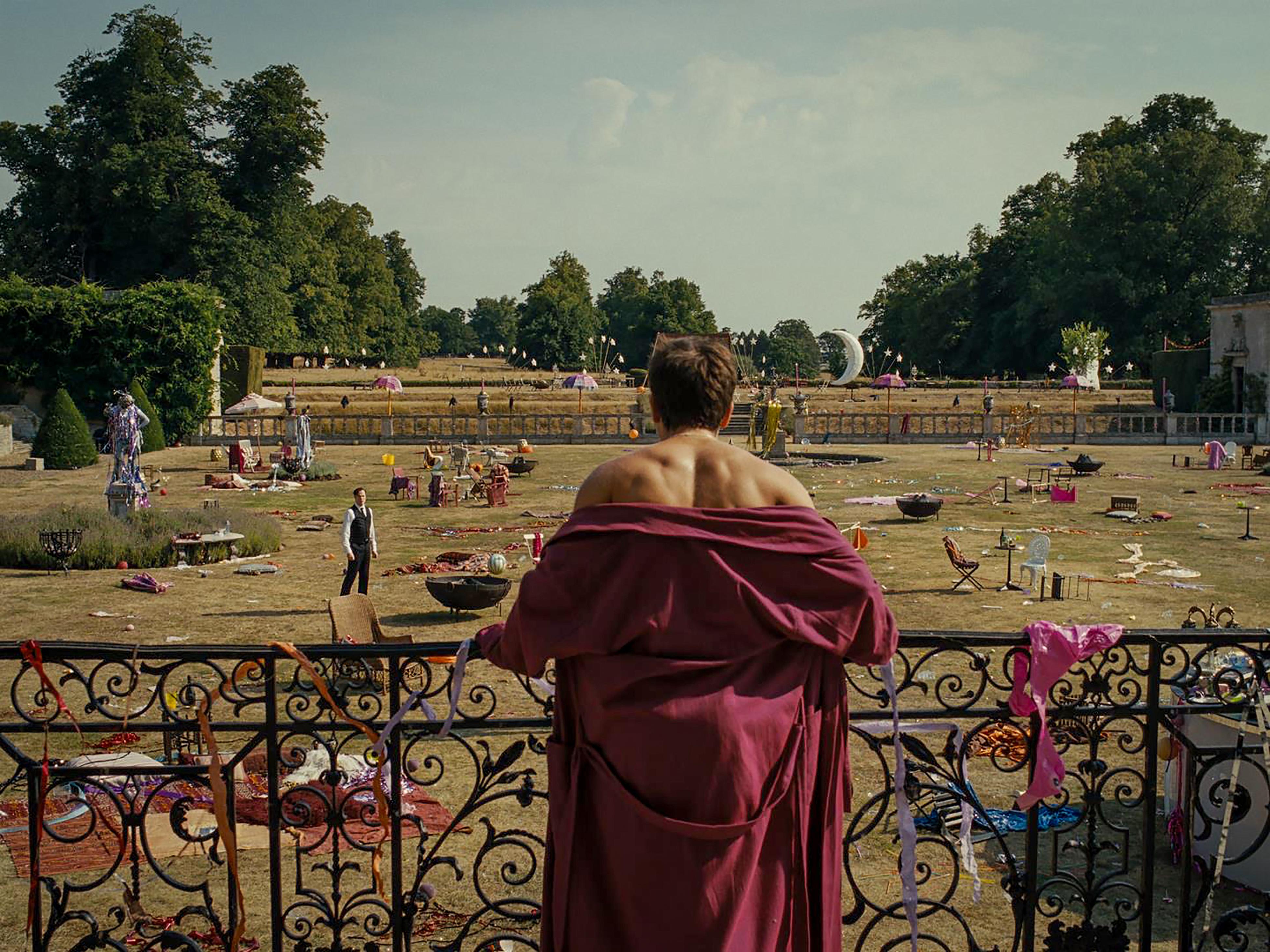
It’s 2006. Oliver Quick (Barry Keoghan) has made it to Oxford. He’s quiet. He’s earnest. He’s from ‘the north’ (Prescot, to be exact). Surrounding him are the children of the elite; thoughtlessly late to tutorials, but having the pedigree and charming RP accents to wrap the tutors around their little, signet-ringed fingers nonetheless. The overwhelming conclusion? This place is not for Oliver. So begins Emerald Fennell’s follow-up to her 2020 debut Promising Young Woman: a darkly comic tale of class, privilege, and desire. When a stroke of luck allows him admittance into the inner circle of Felix Catton (Jacob Elordi), Oliver is invited to spend the summer at his friend’s majestic family home, Saltburn. Oliver becomes enamoured with the opulent, insular lifestyle of the Cattons, and fears that once they tire of him, he will be forced to return to the dullness of ordinary life.
Having attended the same £15,000-per-term school as Kate Middleton and Princess Eugenie, Fennell is well placed to depict the humours and foibles of the upper classes. Her characters are out-of-touch, ridiculously lavish, and yet not entirely unsympathetic. There is a slight unease, though, in a protagonist who is the impoverished son of drug-addicts from Northern England. Have we not seen this all before? Is Fennell herself not indulging in the poverty porn that seems to animate the Cattons? Not quite. Fennell is too assured in her characterisation for such simplicity. And Keoghan, in his first starring role, proves himself more than capable of capturing the subtle, slippery intelligence of Oliver. Fennell has a knack for recruiting the most talented of actors: Rosamund Pike as Felix’s vain mother, Richard E. Grant as his gloriously kooky father, and Archie Madekwe as his prickly cousin all impress. Even Alison Oliver gives a strong performance despite the flatness of her role as Felix’s troubled yet alluring sister.
Saltburn hits all the right story beats, even if they are lifted from Brideshead Revisited. This is no matter. All stories are products of inspiration, imitation, and sometimes downright theft – and Saltburn never feels derivative. The issue is that the surrealism promised by its premise, and its trailer, is not delivered in the feature-length product. Instead of heady visuals we are given something accomplished but decidedly banal. Should we, the viewer, not also become enamoured with Saltburn? Revel in its wonders: its history and almost boundless grounds; its hidden niches and timeless decadence? I’ve never seen a film introduce a manor house hedge maze (the most wonderful of Gothic Chekov’s Guns) and squander its potential so epically. The film wants Saltburn to appear as an intoxicant to Oliver, and yet doesn’t allow the audience to share a taste.
It’s the ending that saves the piece, with a final scene that will cement Saltburn as a success for most viewers. It is a pity, however, that Fennell and co. play it so safe. The film blends black comedy with a psycho-sexual thriller (forget any squeamishness for bodily fluids), but the shock and cringing laughter that erupted throughout my packed screening can’t disguise that there is a lack of boldness here. Humorous, dark, and fun, Saltburn is ultimately too tame for its own good. It’s an addictive watch for its runtime, but it is not mesmerising, and unfortunately, not quite as twisted as it wants to be – or should be. And yet despite not being a complete triumph, the nuggets of brilliance hidden beneath the surface – along with the most ingenious use of Sophie Ellis Bextor’s ‘Murder on the Dancefloor’ put to screen – make it a worthwhile cinema experience.
By Eve Connor (she/her)

 qmunicatemagazine.co.uk