
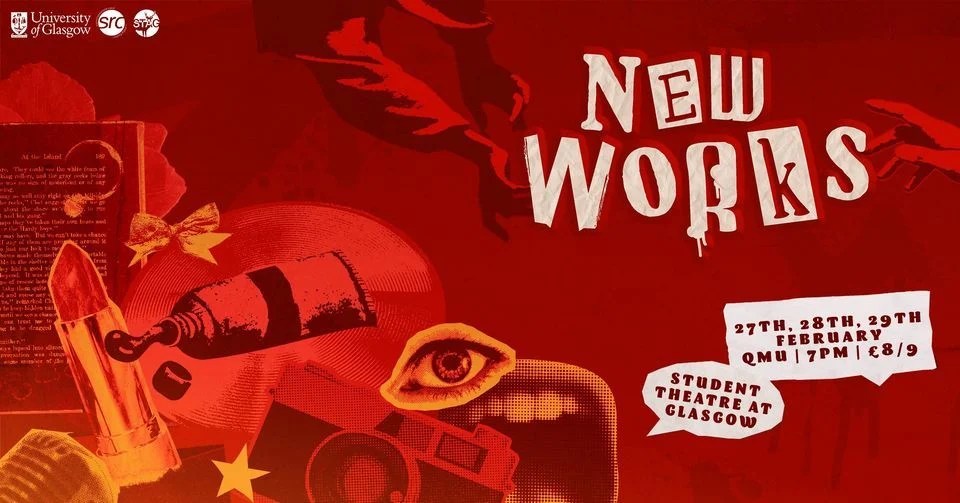
Olivia Campanile and Eve Connor attended New Works Festival, Student Theatre at Glasgow’s annual showcase of original plays.
Night One
The first night of Student Theatre at Glasgow’s New Works Festival showed off two impressive pieces of new writing: Urned It by Katie Whitman, co-directed by Will Gowling and Athena Spillius; and Your Place or Mine by Sofia Macchi Watts, directed by Elizabeth Bin and assistant directed by Briony Conaghan.
First up! Urned It—STAG’s 20-minute play this evening, and an insightful exploration into the world of recent bereavement. Though it could have put a damper on the festivities, the performances and the approach used took this play from potentially gloomy to hilariously dark. The performers committed to their roles fully; a particularly enjoyable impression of The Weeknd by Eve Boyd in no way detracted from the more emotional moments of the piece. The play did not claim to be breaking new ground on what it means to grieve, but presented us with three very different responses, and, through finding the humour in each, pointed out that there is no right way to grieve (but putting your grandmother’s ashes into a teddy bear does not bode well for long-term healing). Unavoidable long scene changes were dealt with in such a way that the audience stayed engaged. Jonas Leipner’s solo ballroom dancing was especially memorable, accompanied by colourful lighting designed by Mia Rinaldi distracting us from the moving set.
Urned It was followed by the 50-minute Your Place or Mine. No risky set movement here, as the set of a cluttered flat living room was simplistic yet believable, and as the actors circled the central sofa, it told me everything I needed to know about these characters and their close friendships with each other. The writing was really the star of this piece – not to discount the stellar performances of the cast. Michael Murray’s turn as Luke was note-worthy, despite his character spending a significant portion of the play lying on the floor, then the sofa. A strength of this piece was how realistic it felt even when telling the improbable story of your flatmate accidentally knocking out your date. This was not diminished by the more creative elements of direction however, which felt like we were seeing into the romantic mind of Beth (played by Laura Callander) and how she was viewing her interactions with Luke. While the actors could have committed a little more to the dance scene used to get Murray from floor to sofa safely, it still worked effectively at sustaining the humour. If Your Place or Mine sets the tone for the rest of the festival, I can’t wait to see what else STAG has to offer this New Works.
The plays were not the only things on show on night one. The University’s String Ensemble started us off, and the Cecilians promoted their upcoming show at the interval. Unlike STAG’s other festival, New Works does not come with a theme, but the large Venue Design team made the QMU Venue look bookish and sweet, celebrating the writing that New Works is all about.
By Olivia Campanile [she/they]
Night Two
The second night of STAG’s annual festival began with a bang, or should I say, the melodic musical stylings of Helena Blackett and Cleo McPhee. With only a guitar to accompany them, their voices twisted and twined in harmony as they treated the audience to beautiful renditions of Joni Mitchell and Big Thief. The perfect start for the evening to follow.
The first play of the night continued to deliver on the standard Blackett and McPhee set, with the original music of Ariel Waxman accompanying the 20 minute Two Sides of the Sofa. Written and directed by Steph Wells and assistant directed by Diana Kukharenko, it was a well-rendered portrait of found family. Carried by the easy banter between Eddie Graham’s Charlie and Mhairi Stewart’s Bella, the piece was a resounding—and poignant—success. Graham, in particular, has a natural, charismatic stage presence, adeptly capturing the caring core hiding behind Charlie’s snarky humour.
A brief interval treated us to two poems by Fran Lee. Powerfully performed, these biting, feminist pieces eased the transition into the final play of the night. The Most Powerful Drug, written by Lewis Cooper, and directed by Cooper and Rachel Glover, had comedy and drama in bucketfuls. No one can fault the intentions nor the potential of the piece: a look at the lasting effect of grief with a dollop of dark humour. Logan Rodgers’s portrayal of Oliver, who clings to his obsession with the children’s webseries ‘Hamstertown’ in order to deal with the loss of his sibling, nails the nervous mannerisms of his character. Adam MacConachie and Rebecca Eggersglusz tie the piece together as the eccentric Hamish and Oliver’s sister, Kim. And yet, it never quite comes together as a cohesive whole. Despite the resonances of its depiction of grief, its over-the-top climax overshadowed much of the emotional work the piece sought to do. With a more subtle touch, The Most Powerful Drug could have been a phenomenal tale of coming-of-age in the face of devastating loss.
Overall, a delightful evening was had. By all accounts, the New Works festival 2024 was a triumph, and a fitting celebration of the vast theatrical talent of the student community.
By Eve Connor [she/her]

 qmunicatemagazine.co.uk