
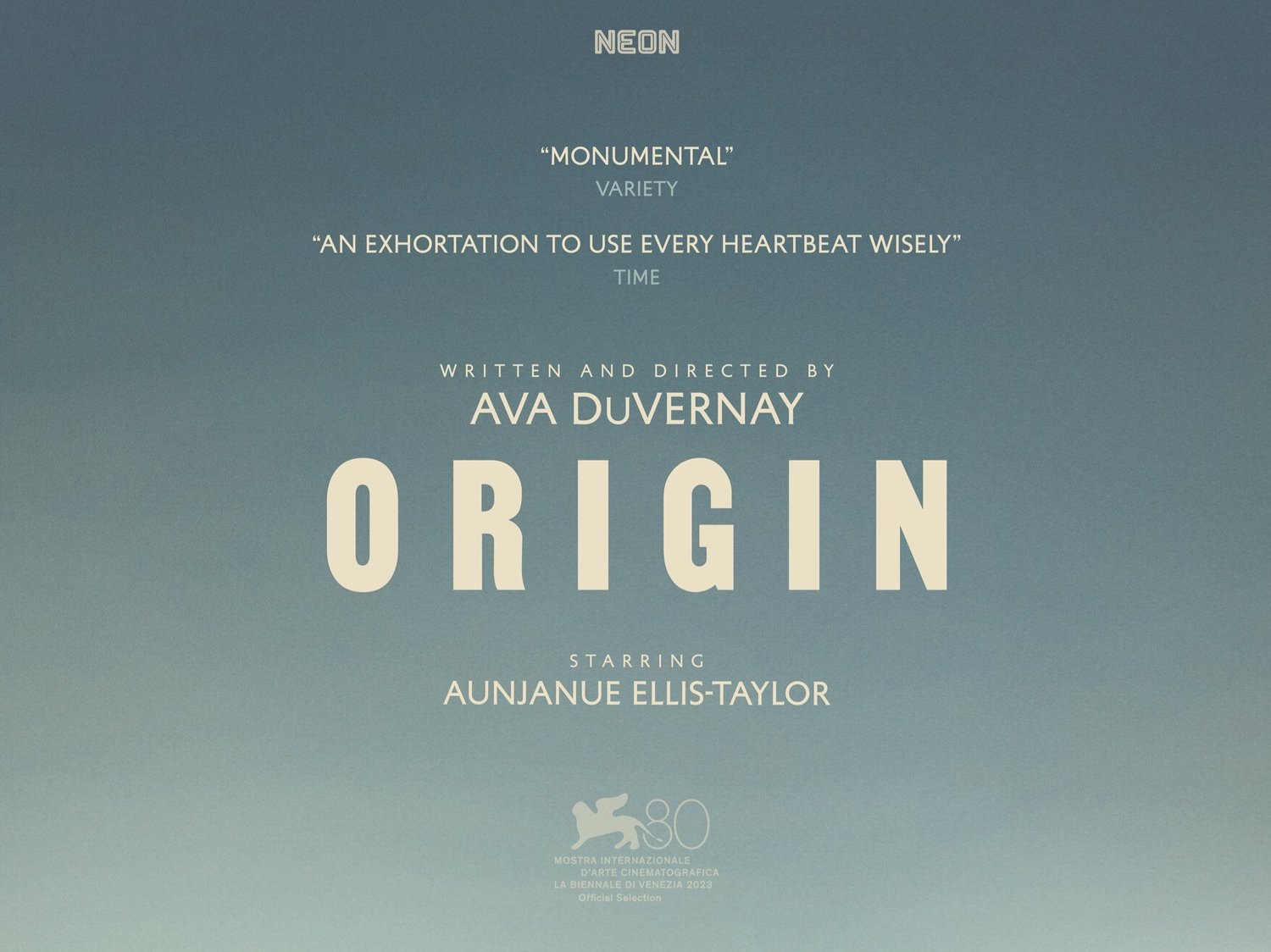
Ava DuVernay’s thoughtful recent feature, Origin, arrived at select Scottish cinemas this year with little fanfare. The newest effort from one of America’s most prominent figures in film and televisual media should reasonably feel like one of the major movie events of the year. However, a botched publicity campaign from distributor Neon has left Origin lingering in a state of limbo since its initial American release last year. The film is a narrativization of the period of personal turbulence in which Pulitzer Prize-winning author Isabel Wilkerson wrote her acclaimed nonfiction text “Caste: The Origins of Our Discontent”. Emerging from a period of professional uncertainty, the sudden death of both her mother and partner propels Isabel (Aunjanue Ellis-Taylor) to investigate the origins of racism and its connection to other forms of social prejudice through the Indian concept of the Caste system.
DuVernay’s intention to construct a cinema of ideas here is admirable, and it should be noted that she is mostly successful in accessibly conveying a deceptively complex idea around the interlinking nature of social hierarchies. However, on the whole, the film fails to weave its message into the narrative in a way that feels natural. Many conversations – particularly one between Isabel and her cousin Marion (Niecy Nash) – feel inauthentic in the clunky way they reduce characters to mouthpieces for the themes of the piece. The decision to have the narrative intercut with scenes dramatising the historical events that inform Isobel’s thesis also feels like a misstep through their reminiscence of documentary-style filmmaking. Such literal renderings of ubiquitous real-life events – including Germany under Nazi rule – cause Kris Bower’s beautifully sweeping score to sink under such heavy historical weight. At times this element of the film is made to feel manipulative rather than evocative, working overtime to provoke an emotional reaction from the viewer where the narrative fails.
Despite its less successful aspects, Origin boasts a myriad of well-executed creative choices which help to lift it beyond the purely polemical. Most notable of these is a standout lead performance from Aunjanue Ellis-Taylor, who carries the narrative for the entirety of its 141-minute run time. Expertly conveying Isabel’s sharp intellect alongside a well-rooted sense of internal melancholy in the face of inconsolable loss. Aiding the effectiveness of this performance is Matt Lloyd’s warm cinematography, which often focuses on close-up shots in order to highlight Ellis-Taylor’s face – an expressive mask of complex and varied emotion – thereby briefly grounding us in the inner life of a compelling character. A particularly strong moment occurs at a gala that Isabel attends shortly after the passing of her mother as she endeavours to explain her developing thesis on the interconnectedness of social prejudice to two white peers, who are vastly unreceptive. Isabel’s overwhelming passion and long-suffered exasperation are portrayed with powerful vulnerability and rawness by Ellis-Taylor in a moment that manages to blend the film’s narrative of personal journey with its engagement with wider social issues.
Unfortunately, though, these moments of seamlessness occur too few and far between for the film to reasonably be considered triumphant as a narrative feature, leading this reviewer to agree with Peter Bradshaw’s assertion in his review for The Guardian that the film perhaps should have in fact been a documentary.1 By approaching an undeniably ripe personal story too cerebrally, DuVernay’s film loses some of its dramatic power along the way. However, despite this, Origin remains a commendable feat in its stature and ambition, even if not an entirely successful one.
[Fergus Kane, he/him]
[Instagram: @fergus_kane]
- Bradshaw, Peter, ‘Origin: a heartfelt look at a journalist challenging the idea of race’, The Guardian (2023) https://www.theguardian.com/film/2023/sep/06/origin-review-ava-duvernay-isabel-wilkerson ↩︎

 qmunicatemagazine.co.uk