
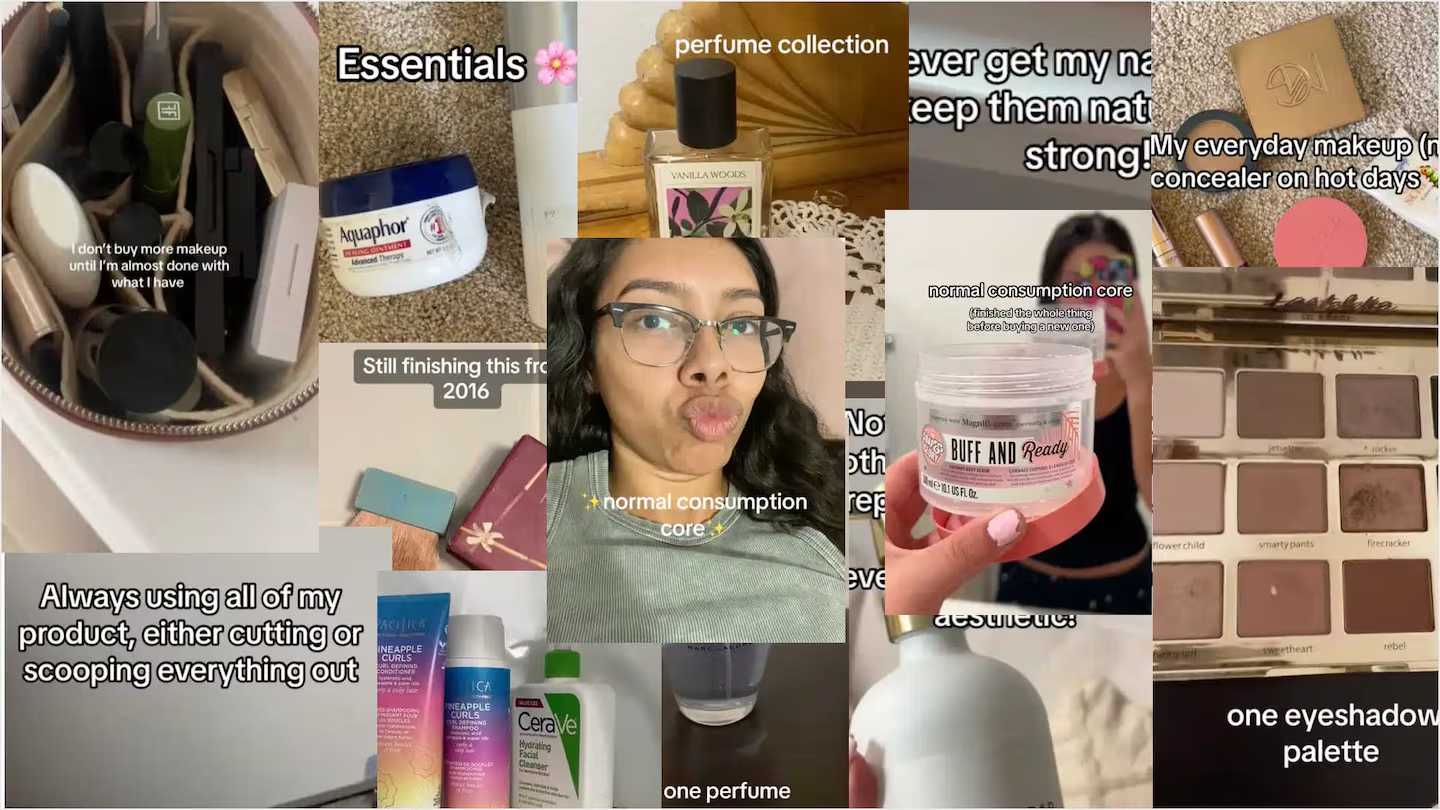
“Cores”, “eras”, and “aesthetic”, are all too frequently labels used by companies and influencers to encourage people to buy products that fit into their niche. It’s the typical paradox of inspiring people to be themselves through replicating blueprints online, designed by corporations and winning them a profit.
However, this summer, TikTok presented “underconsumption-core”- often videos of people with old, reused items, either passed down through their family, or just objects that looked a little past their best. Think crusty makeup palettes, outdated 1960s crockery, beaten-up shoes, etc. These videos are either comedic or glamorous.
At first glance, this kind of trend might be seen as a good thing: we’ve become so used to being compelled to be finding the next big purchase that not over-consuming is now against the norm. If this trend promotes sustainable and mindful consumption, surely this should be celebrated? For context: the consequences of the production of household goods sum to around 45% of global emissions – and fast fashion waste makes up 10% of this: producing 92 million tonnes of waste each year. This is equivalent to a truckload of garments dumped in landfill every second. Additionally, out of the materials used by fashion companies, only 12% is fit to be recycled.
This shows more than ever that we need to pressure systematic change. Shifting to a “circular economy” would mean that companies use materials that ensure all, or at least the majority of, waste produced is cycled back into production. This puts sustainability as a priority over profits. For example, changing what materials are used, or using fabric scraps for more garments. Essentially, if companies producing household goods restructure to this, carbon emissions can be lowered by 40%, as well as numerous positive effects for worker rights (many of which are being threatened in fast fashion companies).
But what this doesn’t mention is the speed of consumer/producer culture. We expect new microtrends faster than ever, leading to over-consumption being the norm. Now, garments have worn an average of just 7-10 times before being thrown away. Underconsumption would benefit a transition to a circular economy as the demand to produce has to become more sustainable.
Many of us might be underwhelmed by the “innovation” of the buying phenomena that “underconsumption-core” promotes. When money is tight, people literally cannot consume what they need, let alone over-indulge. It’s true that some videos lack the acknowledgement that they are choosing to under-consume, rather than being forced to through income restraints. Even more importantly, some of the habits this trend promotes, such as buying one good quality pair of shoes to last instead of many, aren’t accessible to everyone. The upfront costs of making more sustainable choices, as I’m sure you’ve seen on sustainable fashion sites, are not cheap. The idea that everyone can lower consumption by investing in expensive products fewer times is a privileged perspective.
Other criticism of this trend is that it promotes being a “cheapskate” with money, through tailored aesthetic videos. However, looking back at other similar trends like the monochrome minimalism of the early 2010s, or the VCSO girl metal straws mania, you can also see similar patterns of backlash. Is this because it generally is a bit cringe, or is it the markets using their influence online to push people back into their patterns of consumption?
Similar to the “carbon footprint” idea (launched by BP, an oil and gas giant), underconsumption-core arguably targets the individual in taking responsibility for climate change, rather than the growth-orientated capitalist system. It’s clear that most of the emissions are caused by the markets, not a person deciding whether or not to buy an H&M top. But an aggregation of over-consuming drives production. The role of the individual can’t be disregarded completely.
It’s easy to feel powerless in the move against climate change, especially when you hear depressing statistics from news outlets. However, movements that pressure companies to take on real systematic change should not be discarded. And whilst “underconsumption-core” can’t really be defined as a political movement, its surely a start in the right direction to a circular economy. As scientists around the world have concluded, the only real existing barrier to preventing the climate crisis is institutional change – rather than lack of resources (money, technology, etc) – so it is more than possible to reform our system.
Overall, apart from a lack of insights into income inequality, underconsumption-core offers some real advice if you can afford to scale down your shopping and make more mindful purchases. The total of individual actions will ultimately have an effect on climate change prevention, reducing the demand and thus production of wasteful products. Essentially, pressuring those in power towards cyclical economies should be the enduring message from this trend – even if this starts with small personal changes.
By Heather Wilson [she/her] Instagram: [@heather.w4]
Sources:
https://earth.org/statistics-about-fast-fashion-waste/
https://www.sweep.net/insights/trash-talk-how-to-fix-overconsumption-and-waste
Image credit: https://www.businessoffashion.com/articles/beauty/underconsumption-core-trend-tiktok/

 qmunicatemagazine.co.uk