
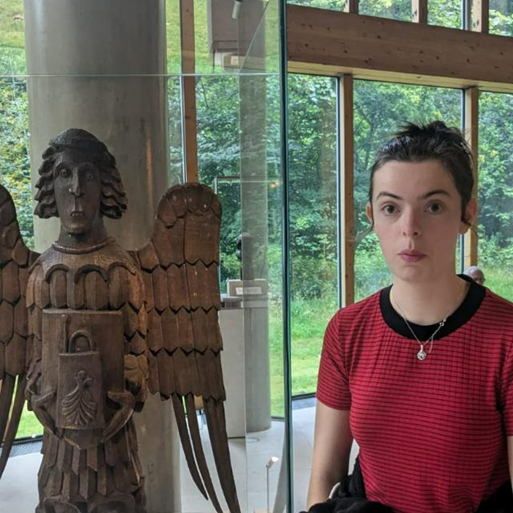
There’s a phrase that’s been floating around social media lately, soft and longing in nature: “You are a museum of all the people you’ve loved before.” We all know the feeling of hearing ourselves say something and realising it’s not entirely our own voice. A phrase borrowed from a family member. A laugh you picked up from a flatmate. A taste for oat milk, tie dye shirts, or Phoebe Bridgers that were inspired by someone who mattered once. You didn’t mean to collect them, but you did.
We live in a time obsessed with self-discovery and self-curation, but the truth is, the things we think make us “us” are often the things that we’ve borrowed. We’re mosaics of stolen phrases, shared playlists, little rituals that once belonged to somebody else. Every person we’ve loved leaves a trace, a colour, a tile in our mosaic. Memory is just another form of exhibition.
Consider how relationships change your daily life in invisible ways. You start ordering what someone else ordered because you want to try it, only then to order it every time. You copy the way a friend rolls their eyes when something’s ridiculous. You start saying “oh my days” instead of “oh my god” because someone you once adored said it that way. You may not talk to them anymore, but the imprint remains soft, unacknowledged, ordinary. It’s melancholic but comforting: a visual reminder that even the people who left didn’t really leave. They’ve become architecture, holding up the core of who we really are.
It’s tempting to see this as solely sentimental, but there’s something deeply practical in it too. Modern life rarely gives us clean emotional closure. We ghost and get ghosted. Friendships drift because of geography or burnout. University, especially, is full of temporary intimacies; flatmates who feel like family for nine months and then scatter to different lodgings. We rarely get a goodbye. The idea of being a museum gives us another way to think about that. Not as loss, but as transformation. Maybe the people who leave don’t disappear; they just become exhibits in the gallery of our lives.
Museums don’t discard their past, rather they honour it. Even when a display is taken down, it’s never really gone. Instead, it lingers in the archive, influencing what’s shown next. Unwanted versions of love and friendship, the emotional leftovers, are tucked away. While not front and centre anymore, the back rooms still hold part of our permanent collection. In doing so, we reinterpret and quietly carry on with what once mattered. You might not recall the name or face of someone you dated briefly, yet you still echo them in small ways. It’s subtle, shifting, always under renovation.
There’s a tenderness in accepting we are not entirely original. The culture we live in tells us to be self-made, independent, only focused on ourselves. But the truth is, identity is collaborative. We build ourselves out of contact. We learn empathy, humour, and taste from each other. Every connection is a small exchange of ourselves. It’s humbling, and realistic, to think of yourself as a patchwork, not a blueprint. Being a mosaic also means being unfinished. Mosaics grow as we meet more people, experience more love, loss, and change. The pattern shifts. Some colours fade, others brighten. Pieces fall off and new ones are glued in. That’s part of the beauty: you’re not a finished exhibit, you’re under constant renovation.
Not all tiles in the mosaic are pretty. Some are sharp-edged, painful, cracked. The people who hurt us, or the versions of ourselves we were with them, also live somewhere in the gallery. But even those fragments serve a purpose. They give contrast, texture, and depth to the rest. Feeling complete doesn’t come from perfection, but it comes from forming a dialogue between the best and worst parts of ourselves.
You are not static. You are a living gallery, a work always in progress, a collage of love, memory, and influence. And maybe that’s the most beautiful thing about being human. We don’t stay whole by staying untouched. We stay well-rounded by being collaborative projects to each other, by having every person we’ve ever cared for leave a piece of themselves behind.
At a time when so many of us are trying to “find ourselves,” maybe the answer isn’t about discovery, but recognition. We’re not lost. We’re layered. The task isn’t to strip away the people who shaped us, but to acknowledge them. To thank them, even, for their contribution to our newest edition.
Imagine yourself as a museum. Walk through the halls, carefully pierce together what rooms there may be and how they would look. Which songs would play in the background? What photos would hang on the walls, and which would be front and centre?
Or maybe you prefer the mosaic image. If you could step back and look at the pattern of your life, what colours would dominate? What shapes repeat? Which pieces don’t quite fit yet, but will someday make sense?
Eloise Reid [she/her]

 qmunicatemagazine.co.uk