
From marching on roads, to holding a banner that gets you imprisoned, to entering international waters – what is protest if it is not disruptive? Disruption is not a potential accident of protest – it’s the purpose.
On October 2nd, 2025, over 400 activists — including Greta Thunberg — were intercepted at sea while crossing into international waters as part of the Freedom Flotilla. Their aim: to break the siege on Gaza and deliver aid to a population living through famine. They never got there.
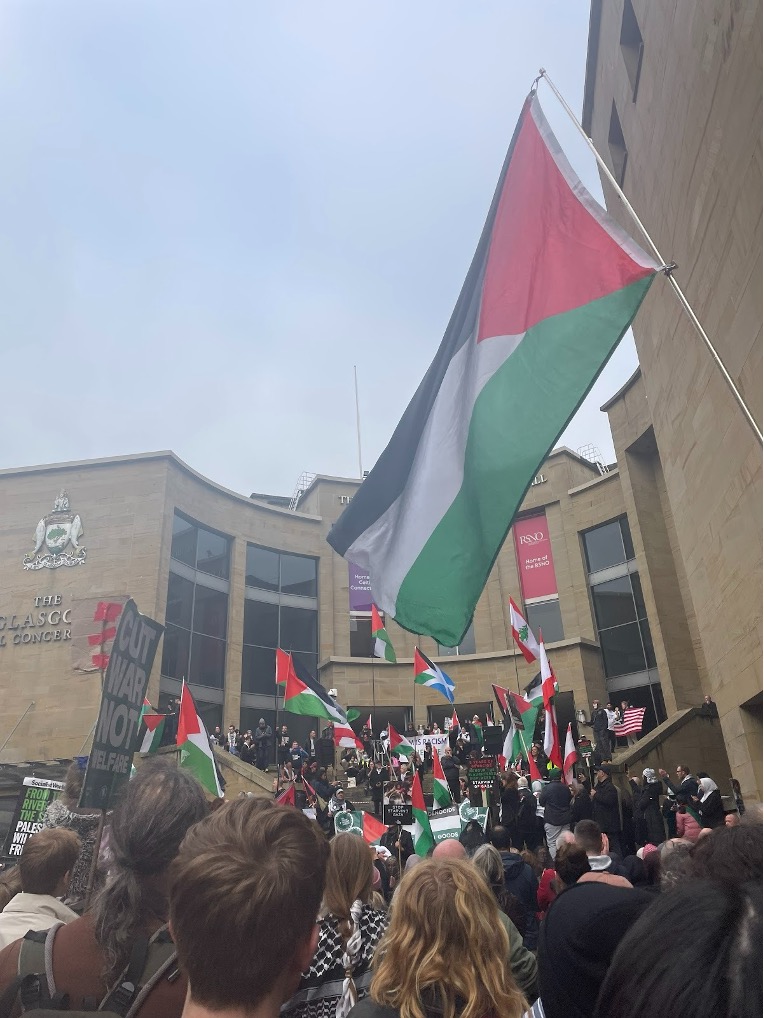
The next weekend, on October 11th, I marched through the streets of Glasgow. Alongside thousands of others, we protested something beyond a Trumpian ceasefire, something that wouldn’t be violated again and again and again. The protest, as it had been for two years, was peaceful — but it was also disruptive.
Open-top tour buses logged between banners, tourists staring. Commuters delayed. Window shoppers unable to browse. Cars stuck in traffic jams. Yet democracy, in its chaos, spilled into the streets. You’d think that after two years, the city would have grown tired. But as we turned the corner by Buchanan Galleries, cars honked in rhythm with our chants. My mum and I — who, alongside my dad, have festered the protest instinct in me since I was a toddler — stood there, speechless. Buchanan Street was alive.
Palestinian stalls sprawled across the pavement, handmade scarves and tote bags piled high. Speakers from all walks of life took turns at the mic, crowds surging forward to listen.
A child, no older than three, sat on his father’s shoulders, waving a Palestinian flag that was far too big for him. Despite the cliché, that’s where it all begins. One minute you’re small, watching adults chant, wave banners and walk on roads – things you’re told off for doing – and the next it’ll be you. Anger at the news becomes a post. A post becomes a protest. A protest becomes a march.
If anything is to be taken away from that march – regardless of the cause – people, of all walks of life, are willing to challenge injustice. To fight repression and disrupt the status quo.
Because protests must disrupt. From freedom flotilla activists on the water, to a protest in the city centre. It’s meant to stop traffic, to force a pause in ordinary life, to cause inconvenience. And while a pain in the ass, it’s an essential part of democracy. Historically, the line between protest and crime has always been thin, redrawn constantly to fit shifting social norms. From the Suffragettes to the Chartists, resistance has always been branded dangerous, deviant and disruptive — until history rewrites it as democratic. Governments equate dissent with danger, punishing those who resist.
The 2022 Police, Crime, Sentencing and Courts Act, was a law supposedly designed to deter disruption. Instead it has led to thousands of arrests — from climate activists to those prescribed now as terrorist organisations. This month, new proposals want to prosecute disruptive “continuous protest.” That won’t just target weekly Palestinian demonstrations, nor the annoying climate activists blocking roads. Instead, it prevents essential parts of democracy and forums for accountability.
On October 23rd, I spoke to Jan Goodey, a non violent climate activist and journalist who was the first person arrested under the 2022 Act. His crime: holding a banner on the M25 as part of a just stop oil protest. His sentence: nine months in prison, 6 served.
“I thought I’d get a week,” he told me, smiling. Instead, he spent Christmas behind bars.
“When you’re a Just Stop Oil protester, you’re trained not to raise your hands — we’re non-violent,” he said.
What struck me most was how he spoke of solidarity between political prisoners, others smuggling in The Financial Times, charities reading children’s stories to them at night. Characters he’d met through activism, whom he may never have otherwise come into contact with. His first memory of activism was donating to Oxfam, and saving trees from being cut down.
Jan spent time in Belmarsh and Wadsworth as part of his sentencing. These places once housed terrorists. Jan — a man protesting to save lives and trees — was treated the same. He disrupted; therefore, he was punished.
His friend Chris, another activist, admitted he’d never go to jail for a cause. But he still calls himself an activist. He plants trees, campaigns locally, writes letters.
“Activism”, as he stated, “is what you make of it”.
Upon reflection, October was a month whereby I was constantly surrounded by different walks of it, whether that be marches, conversations or simply reading about a policy online. Protest doesn’t belong to one kind of person or one kind of courage. It’s a spectrum.
Time and time again Freedom Flotilla, is intercepted in international waters where the “law” stops at an invisible line. But that’s what activism is: testing boundaries until the message sticks. And on October 2nd, it did. This movement involved and disrupted 44 different nations. That brief disruption gave Palestinians the right to fish.
Yes. Fish.
While governments tracked, detained, and silenced activists, Gazan fishermen finally cast their nets. For a moment, they had food. For a moment, they had freedom.
And that—by every measure—is a victory.
Whether small or big, alone or among many, to stand up — to, to protest — is to disrupt. A moment to look back on and say
I stood for something.
Scarlet Morrison (she/her)

 qmunicatemagazine.co.uk