
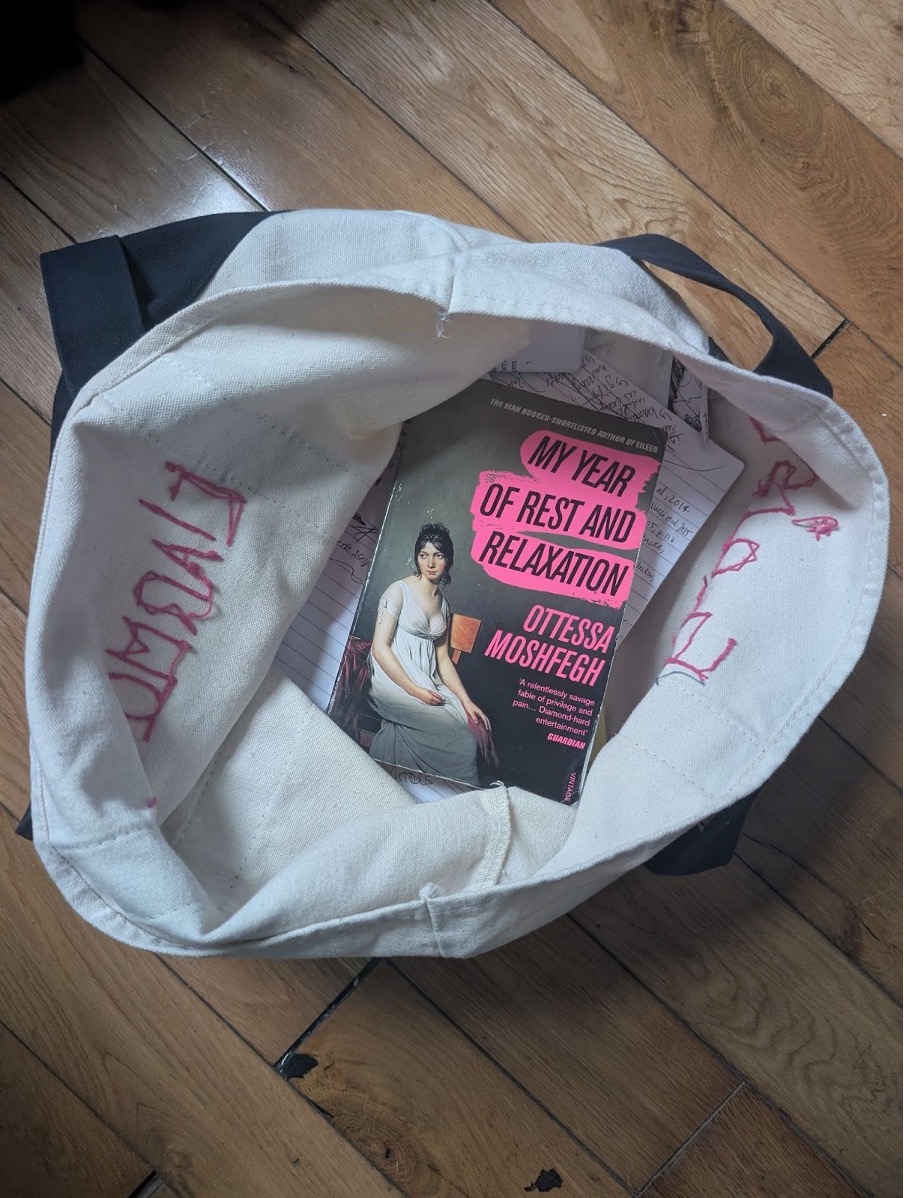
Ottessa Moshfegh’s My Year of Rest and Relaxation is usually discussed as a story about withdrawal, excess, or boredom among the wealthy. But one detail that struck me while reading it was how often the narrator quietly questions the things people assume are meaningful. She does not do this in a philosophical way. Instead, she notices small contradictions in how people behave. The result is a novel that feels less like a story about sleep and more like a strange investigation into how people assign meaning to their lives.
The premise is famously simple. A young woman in early-2000s Manhattan decides to spend a year sedated, sleeping through as much of life as possible with the help of an extremely questionable psychiatrist and a rotating set of medications. It sounds ridiculous, and at times it absolutely is. The book is very funny in places, mostly because the narrator describes everything with a flat indifference that borders on deadpan comedy. Her doctor prescribes increasingly absurd combinations of pills. She sleepwalks through errands she cannot remember. Her apartment becomes both sanctuary and laboratory for this strange experiment.
But the novel works because the narrator is constantly observing the world around her with sharp, almost accidental insight. She notices small habits and assumptions that everyone else seems to accept without thinking. One line that stayed with me appears early on when she asks, “Did they know that glory was mundane?” It is such a simple question, but it captures the tone of the entire book. The humour particularly works because the narrator never seems particularly shocked by what is happening.
The unnamed protagonist spends time around people who are meant to be impressive. She knows people in the art world, people with money, people with beautiful apartments and carefully curated lives. Yet she seems oddly unimpressed by it all. Instead of seeing glamour, prestige starts to look procedural. The idea that glory might actually be mundane becomes less cynical and more observational. Reading that line as a student felt oddly familiar in the context of prestigious internships, academic prizes, and competitive programmes.
Perhaps the most quietly interesting idea in the novel appears in a brief line where the narrator says, “pain is not the only touchstone for growth.” This sentence challenges a familiar story about how people are supposed to develop. Many narratives about success or personal change revolve around struggle. Characters endure difficulty, hardship, or exhaustion, and through that suffering they become better versions of themselves. Students are often told that every experience must contribute to some larger arc of development.
The narrator seems sceptical of this idea. Her year of sleep is unusual, but it is also an attempt to see whether change can happen without that constant pressure. She does not frame it as a healing journey or a productivity hack. In fact she avoids the language of improvement entirely. Instead, the experiment feels more like curiosity. What happens if she simply does not feel the need to monitor her progress through metrics?
Her behaviour is often selfish and occasionally cruel, particularly in her treatment of her friend Reva. However, her approach is never suggested to be admirable or reprehsensible, just simply practical. Moshfegh does not romanticise her protagonist or present the sleep experiment as a wise solution to anything.
What makes the book interesting is that it allows the narrator to observe life from a slightly removed position. Her observations are not grand philosophical arguments. While everyone else continues pursuing status, beauty, or recognition, she finds these pursuits hypocritical and notes how a lot of student life involves learning how systems work and then learning how to perform well inside them.
For a novel where very little technically happens, My Year of Rest and Relaxation leaves you thinking about these small decisions long after finishing it. The narrator’s experiment may be absurd, but her observations are complex, abstract and yet deeply refreshing.
A lot of the novel’s appeal comes from the narrator’s voice. She rarely tries to soften what she is thinking. Her observations about people are often blunt, sometimes unfair, but always very clear. That directness makes the book easy to read even when the events themselves are repetitive.
Moshfegh never pushes these ideas too far. She simply lets the narrator notice them. That restraint is what makes the book feel less like a moral lesson and more like a sharp, slightly strange commentary on how people decide what matters. In the middle of university life, where everything seems to be building toward the next achievement, this book seems more relevant now than ever.
Author: Eloise Reid (she/her)

 qmunicatemagazine.co.uk