
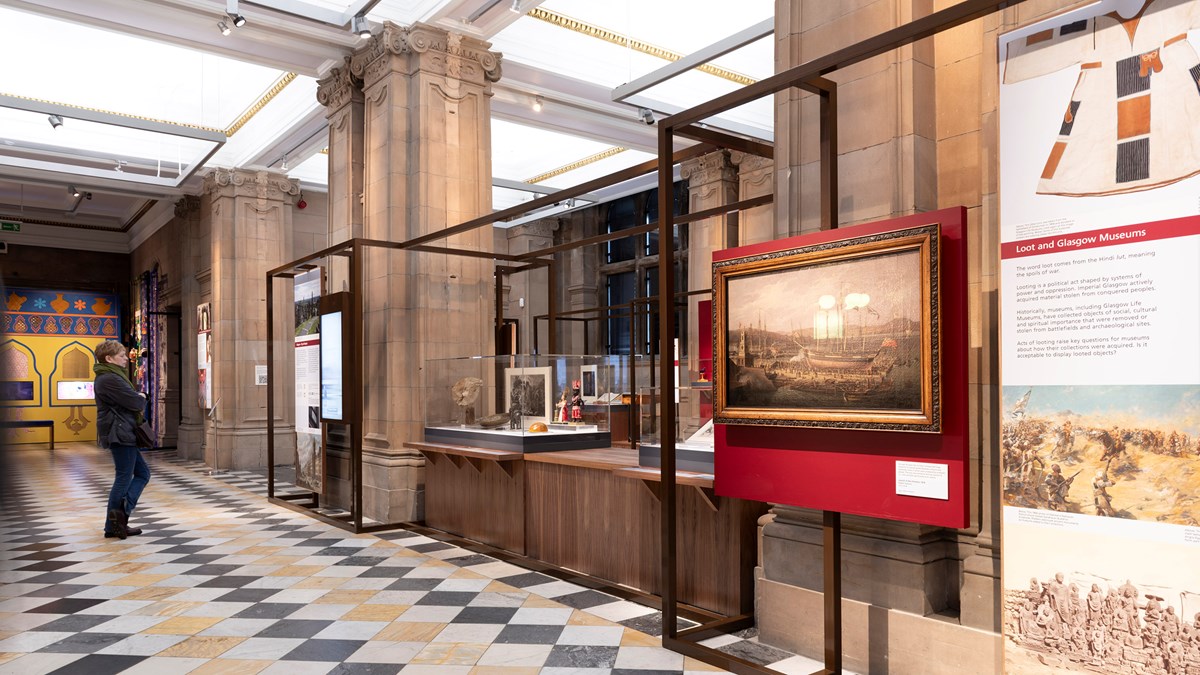
Qmunicate writer Ellie Griffith interviews Nelson Cummins, curator of Legacies of Slavery and Empire at Glasgow Museums. They discuss the new permanent exhibition at Kelvingrove Art Gallery and Museum entitled Glasgow—City of Empire which ‘combines historic and contemporary objects to explore how we can better address the histories and legacies of transatlantic slavery and British colonialism.’
EG: Firstly, could you explain your what your role is at Kelvingrove Art Gallery and Museum?
NC: Yeah, of course, I’m the curator of Legacies of Slavery and Empire, so I’m responsible for our work across all our different museum sites. [The role] looks to better acknowledge and address how the histories of British colonialism and transatlantic slavery have shaped our museum spaces but also the wider city in which our museums are located as well.
EG: And thinking about the new exhibition specifically, what was your role in that?
NC: I was one of the curatorial leads on the project. So, the process of the display itself was started by my predecessor in the role, Miles Greenwood, who’s now at the slavery museum in Liverpool. He was the curatorial lead on the project for the first half of it, then he got his new job, and moved away, and then I came in and took over the second half of it. We worked with a group of young people, Our Shared Cultural Heritage Changemakers, who were involved as co-curators. There was a lot of work with them and the wider team on the interpretation text, object selection, and scripting for the videos in the display. Like all of our projects, it wasn’t just myself, it was a big team effort.
EG: I’m not familiar with the Our Shared Cultural Heritage Changemakers group, how does it work? How did they become involved with the project?
NC: It’s a British Council project which functions in Glasgow and Manchester, within the different groups and museums there. It’s specifically targeted at people with South Asian heritage and in terms of their role in Glasgow Museums, they worked with Miles Greenwood initially on a set of interventions in Kelvingrove Art Gallery & Museum. Their involvement in this display was very much a product of them being a group that Miles Greenwood had previously really enjoyed working with, and he valued their work, so he was keen to involve them in this project. In the display itself they were co-curators. They were a big part of the project team, they had a really big influence on the themes. They were also paid a living wage for their time…Part of the project was recognising areas where we could support them with things such as skills development.
EG: I’m aware that you weren’t involved at the start of the project but do you know how the inspiration and initial ideas came about?
NC: A lot of it comes from the history of Glasgow, and some of it is influenced by previous work that we’ve done. In some of our other museum spaces we’ve talked about things like slavery, but we’ve done it in a way that’s very focused on describing, for example, someone as a tobacco lord, and not talking about what them making money from tobacco meant, in terms of enslavement and the suffering of people who were enslaved. So some of it was inspired by wanting to circumvent that and change the approach that we had in other spaces. I also think we’ve been heavily influenced by other projects in heritage and culture as well, for example The Hunterian’s Curating Discomfort, as well as other displays across the UK, like at the Slavery Museum. We’ve also been influenced by activism in Glasgow such as the Black History work that takes place in Glasgow every year, particularly telling the history of slavery and empire in Glasgow.
EG: The exhibition is described as having both historical and contemporary items, can you tell me what this means in practice and what was the process of selecting items?
NC: There are objects in there that were made over 100 years ago so are more historic, and the contemporary pieces tend to be more artworks that, quite often, are inspired by historic events. We have a sculpture of Rani of Jhansi, who was a freedom fighter in the Indian war of independence. Even though it’s a sculpture of a historic figure, it was made in 2013, so it’s quite a recent, contemporary piece. We also have contemporary pieces that comment on present day racism; we have a Sheku Bayoh street sign that was put up by the Green Brigade as an example of anti-racism activism and campaigning in Glasgow’s recent history. The historic pieces are more about slavery and empire in the past, and the contemporary pieces are more related to present day racism, even though there is sometimes a blur between the two. Our collection is a product of empire as well, and a product of what was valued, therefore contemporary pieces are drawn upon to represent the histories of victims of colonialism.
EG: Slavery and colonialism are very complex topics, how has the exhibition made these topics accessible and engaging for younger age groups?
NC: As part of the exhibition, we had a lot of input from our learning and access team who do all of our schools workshops, and workshops with young people. They have played a big part in shaping the language and content to make it accessible. We also offer a workshop for primary and secondary schools around the exhibition as well. A big thing is having a mixture of content in it, recognising that school groups in particular—but this applies to adults too—don’t want to see just lots of words on the wall. So having digital and engaging objects helps. We wanted to draw people in to learn about a subject that’s super important.
EG: What would you like visitors to take away from the exhibition?
NC: I’d like people to get an appreciation and sense of how much of Glasgow’s past and present is connected to and shaped by slavery and empire. As a team working on the project, one thing we were really struck by is how different Glasgow would look without those connections, and how much they shape the everyday of anyone who lives in Glasgow.
EG: In what other ways do you think Glasgow Museums can continue to address the city’s involvement in slavery and colonialism?
NC: A lot of the work we do with schools and young people plays a big part. As important as exhibitions are, they’re just one side of the museum’s work. Also, doing more research on our collection; we’ve recognised that, even though we’re doing more and more collection research, we still don’t know the full picture of the objects in our collection, and their connection to colonialism. We also have to think about how we can embed anti-racism practices into our wider work and not just see it as part of working on different displays, and to actually see it as part of everything we do. This approach can give us a clearer picture of how, not just the city of Glasgow but also Glasgow Museums have benefited from empire and colonialism. We want to not just address and acknowledge that, but also to go some way to atoning for it as well.
EG: If you were to sum up the exhibition in just three words, what would they be?
NC: Engaging. Overdue. Necessary.
Glasgow—City of Empire is a permanent display which can be found on the South Balcony at Kelvingrove Art Gallery and Museum.
[Ellie Griffith, she/her]
[Instagram: @e.lliegriffith]
Image Credit: https://www.glasgowlife.org.uk/museums/kelvingrove-art-gallery-and-museum/glasgow-city-of-empire from Glasgow Life


