
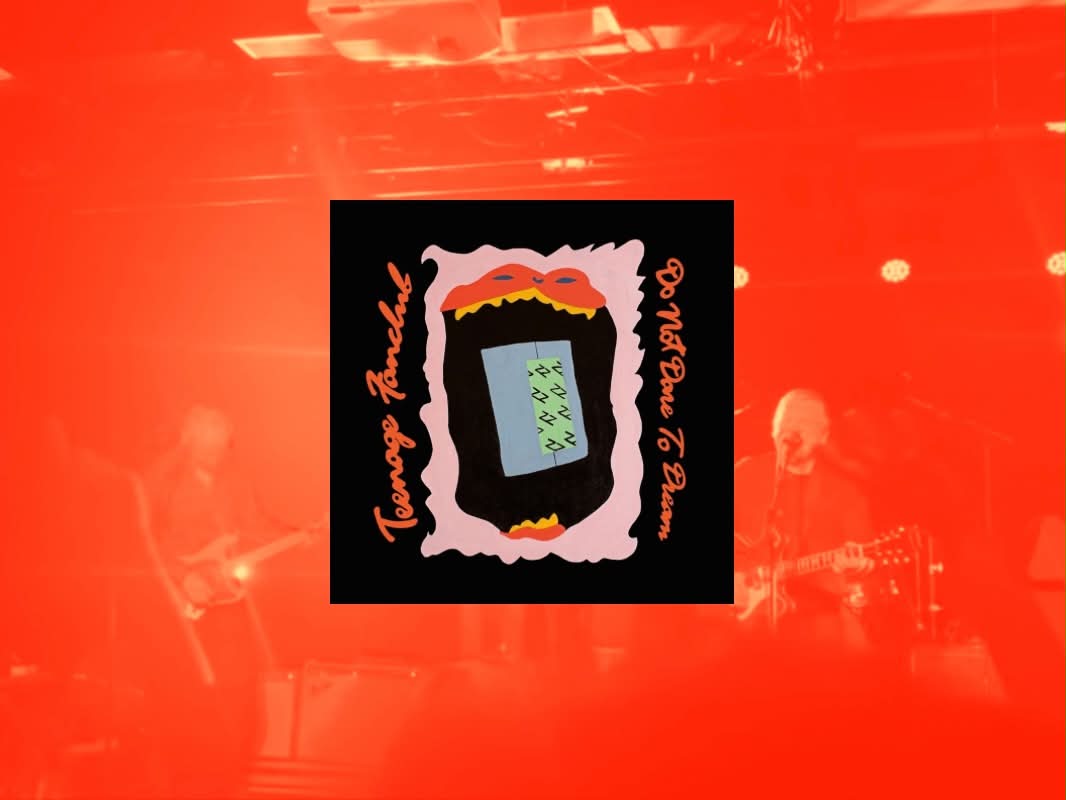
Teenage Fanclub are among Scotland’s most consequential musical acts. Their latest outing recontextualises the band’s last two albums, and reflects the strength of co-founding songwriters Norman Blake & Raymond McGinley’s 37-year partnership, narrating renewed contentment with life’s constants in the face of a changing world.
Sonically, Do Not Dare To Dream continues the story of the 2020s’ Teenage Fanclub. Since the turn of the century, the band’s Americana-inspired style has steadily grown softer and more folksy, and their youthful brashness wiser and more introspective. As with their last two albums, Do Not Dare To Dream’s opening track sees Norman Blake chart his progress on the path to contentment in his middle-age.
Home opened 2021’s Endless Arcade with an aching uncertainty informed both by the 2018 departure of co-founder, bassist and songwriting powerhouse Gerard Love, as well as Blake’s move back from Canada to Glasgow following the split of his marriage. Nothing Lasts Forever (2023), and its opening track Foreign Land, release the built-up angst and nostalgia with forward-facing acceptance, as he goes from lamenting “I sometimes wonder if I’ll ever be home again” on one album, to acquiescing “the past’s a foreign land, I did my best, you understand” on the next.
Now, the new project opens with a gentle, melodic jaunt which reads at first like a love song. Without prying into Blake’s love life, however, its repeating title lyric “There Was You” across the chorus and outro works better as an ode to life’s constant comforts – family, friends, music, and all the rest we turn to at every age.
The following tracks, penned by the relatively elusive Raymond McGinley, match Blake’s reinstated vigour for familiarity – anchored around the synth breakdown in Tomorrow People, he sings about “liv[ing] in happiness, while the world descends.” In the steady sombre of Over and Over, the songwriters harmonise to perfection with keyboardist Euros Childs about the need to “fall in love, over and over again.”
Childs takes advantage of Black Bay Studio’s church organ to lend the track’s final stretch a distinctive melancholy. The songwriters have spoken of the studio’s influence on the album’s identity, as McGinley’s The Same Air does for the location; trapesing around the remote Outer Hebrides between recording sessions, the area’s ancient history left the band collectively in awe at music’s permanence. The thesis in the tracks’ chorus – “we breathe the same air, as those no longer there” – is especially resonant from a band who’ve now outlasted musical generations.
Through this lens, the straightforward optimism of Blake’s Be With You Tonight is recontextualised. With brasher vocals and its well-placed guitar solo tastefully distorted, the track wouldn’t be out of place in the band’s Creation-era heyday. As is, it reflects Teenage Fanclub in their current form; Blake sings warmly about newfound and hard-fought contentment, but his and the band’s softened edges haven’t cost them their second-guessing wit.
Blake has told how the title track, I Do Not Dare To Dream, which centres the cautious optimism seen throughout the album, continues the band’s dryly sarcastic songwriting tradition.
As with the irreverent debut title A Catholic Education, the 1997 album Songs from Northern Britain’s tongue-in-cheek reference to the band’s Scottish roots, and the aforementioned Nothing Lasts Forever’s sarcasm in light of their three-decade run, the track’s name mocks the slogan-istic optimism rampant across pop music.
The album’s final stretch cements its core messages. Take Time sees McGinley balance introspective reflection and prescient optimism between its refrain and chorus, accompanied by his co-founder’s signature high harmonies throughout, while his restrained album-closer Young and Wise sees some of the album’s most inward-facing lyrics.
Meanwhile, in between, Blake’s Day In The Sun and Somewhere To Land affirm newfound vigour for a life “that feels like it’s only begun” and “lifting my head from the sand” of uncertainty, respectively.
Ending the record on each songwriter’s quiet reflections after having lead with their idealism is a strong choice, and ensures Do Not Dare To Dream sits comfortably within Teenage Fanclub’s catalogue. After all, the album’s answers belong to questions the band have asked since the anthemic debut single and perpetual encore-ender Everything Flows. A 24-year-old Norman Blake once anguished over the anxiety of an uncertain future, and lamented the feeling of people and things stagnating against the pace of a changing world.
Author: Isaac McCrory(He/Him)
@isaacswriting


